Pace Makes the Race: The One Concept That Separates Sharp Bettors
Every professional handicapper will tell you the same thing: figure out the pace scenario and half your work is done. Here's the framework we use daily.
Drew
Lead Handicapper · Aces & Races
Why Pace Is Everything
Every professional handicapper will tell you the same thing: figure out the pace scenario and half your work is done. Pace analysis is the single most powerful handicapping tool available to the public bettor — and the most underused.
The basic idea is simple. In a race, early speed horses battle each other for the lead. When too many of them are in the same race, they burn each other out, leaving the closers with an easier target. When a single speed horse gets a free, uncontested lead, it often gets an easy enough trip to hold on at inflated odds.
The market doesn't price this correctly. Casual bettors pick horses based on past performance headlines — last race finish positions, names they recognize, trainers they follow. Almost none of them are thinking about what the first half-mile of this specific race looks like.
The Basic Pace Framework
When we approach any race, we start by categorizing each horse into one of three running style buckets:
- E (Early) — horses that want to be on the lead or near it in the first fraction
- EP (Early/Presser) — horses that settle just off the pace in the first few lengths
- S (Sustained / Closer) — horses that save ground early and run their best in the final stretch
Once you've classified the field, count the E and EP horses. That count tells you the likely pace shape of the race.
Pace Shape Scenarios
Lone speed: One E horse with no rivals for the lead. This horse is going to get a soft, uncontested lead at whatever fraction it wants. These horses win at a dramatically higher rate than their odds suggest — look to bet them and look to beat them only with horses that have demonstrated the ability to close against a slow pace.
Contested pace: Two or more E horses going at it. Expect hot early fractions. The speed horses will tie each other up, and closers will get a favorable setup. This is where late-running horses, often overlaid at the windows, have their best opportunities.
Lone closer: Occasionally you'll see a race where there's genuinely only one closer and every other horse wants to be on the lead. That closer will have to make up enormous ground — the pace scenario works against it even if its raw figures are strong.
Reading the Fractions
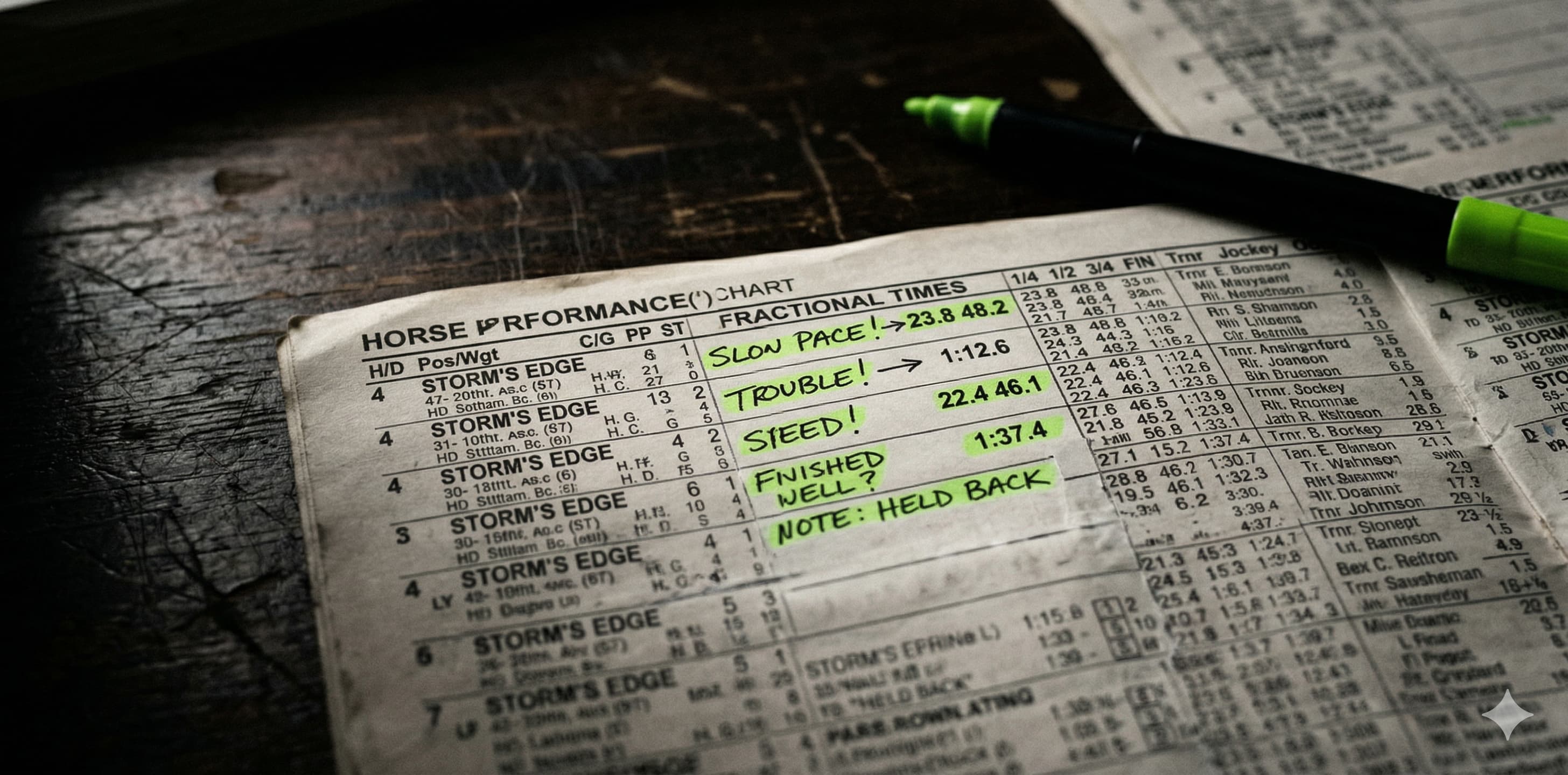
Pace analysis is most powerful when you combine running style classification with fractional time analysis. The two key splits we watch are:
- First call fraction (typically at the 2f or 4f mark depending on distance) — this tells you how fast the pace was through the first part of the race
- Final fraction (last 2 furlongs) — this tells you how much horse was left at the end
A horse that ran a blazing first fraction and still finished well is showing real class. A horse that benefited from a slow pace and still got caught late is a trap — its figure looks better than it really is.
At Aces & Races, one of the first things we do with every race is build a pace map. We plot each horse's expected running position at the first call and at the stretch call. When that map reveals a clear pace mismatch — a lone speed horse, a pace duel setting up perfectly for a closer — we weight our model output accordingly.
Track Bias and Pace
Pace analysis doesn't happen in a vacuum. Track bias — the tendency of the racing surface to favor certain running styles — can either amplify or nullify a pace setup.
On a speed-favoring track, a contested pace scenario may not produce closers the way it would on a neutral surface. The track is helping speed hold on. Conversely, a closer-favoring surface turns even modest pace pressure into a winning setup for deep closers.
When pace scenario and track bias align — for example, a lone speed horse on a speed-favoring surface, or a deep closer on a track that's been coming home strong all day — those are the highest-confidence plays on any given card.
Putting It Into Practice
Here's a quick checklist we use before every race:
- Classify each horse's running style from its past performances
- Count the early speed horses — identify if there's a lone speed or a pace duel shaping up
- Check recent track bias data — is the surface favoring speed or closers?
- Identify the horse that benefits most from the expected setup
- Compare that horse's morning line odds to the advantage it has in today's specific pace scenario
The horse that's getting a free trip in a race its peers can't run with it? That's where value hides. And value is the only thing that matters in the long run.
For a deeper dive into pace frameworks, trip notation, and applying pace scenarios to real race cards, read our complete Pace Analysis guide.
Want to see our pace maps applied to today's card? Join the Edge — members get full pace analysis on every race, every day we cover.
Want picks like this every day?
Ranked picks with win probabilities, bomb & value alerts, exotic ticket builds, and Pick 3/4/5 sequences — delivered before first post every morning.
Join the Edge — $14.99/mo →