How Aces Edge Ranks Every Race: V1 vs V2
Edge ranks every race twice: V1 asks who is fastest, V2 asks who is fastest in this race shape. Here is what each model weighs and why the order changes.
Drew
Lead Handicapper · Aces & Races
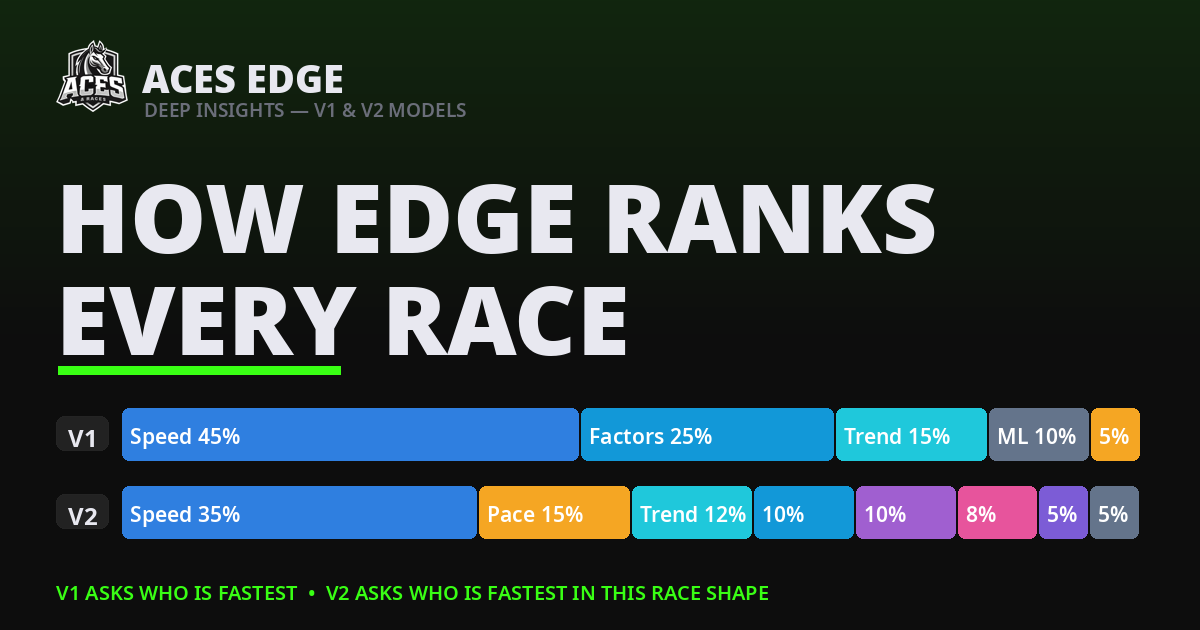
Every race on Aces Edge carries two rankings. Open any race page and the field is ordered twice, once by our V1 model and once by V2, each with its own win probability. Members ask us all the time why the two lists disagree, sometimes by several places, when both models are looking at the same horses.
The short answer is printed right on the site: same horses, different question. V1 asks who is fastest. V2 asks who is fastest in this race shape. This post walks through exactly what each model weighs, factor by factor, so you can read any Edge ranking and know what it is really telling you.

What each model weighs, straight from Edge.
V1: the speed model
V1 is the original Edge model, and it is built the way classic speed handicapping is built: the figure is king. Here is its recipe:
- Speed 45%
- Factors 25% — a grouped bundle of supporting form factors
- Trend 15% — the direction of a horse's recent form
- Morning line 10%
- Pace 5%
What that means in practice: if a horse owns the best speed figures in the field, V1 will usually have it on top, and the rest of the order follows the figures down. V1 answers a clean question, and it answers it well: on raw ability, who is fastest?
V2: the race-shape model
V2 starts from the same data and asks a harder question. Not just who is fastest, but who is fastest given how this race sets up: the pace scenario, the class level, the layoff, the recent trend. Its recipe looks different:
- Speed 35%
- Pace 15%
- Trend 12%
- Factors 10%
- Class 10%
- DSLR 8% — days since the last race
- Standout efforts 5%
- Morning line 5%
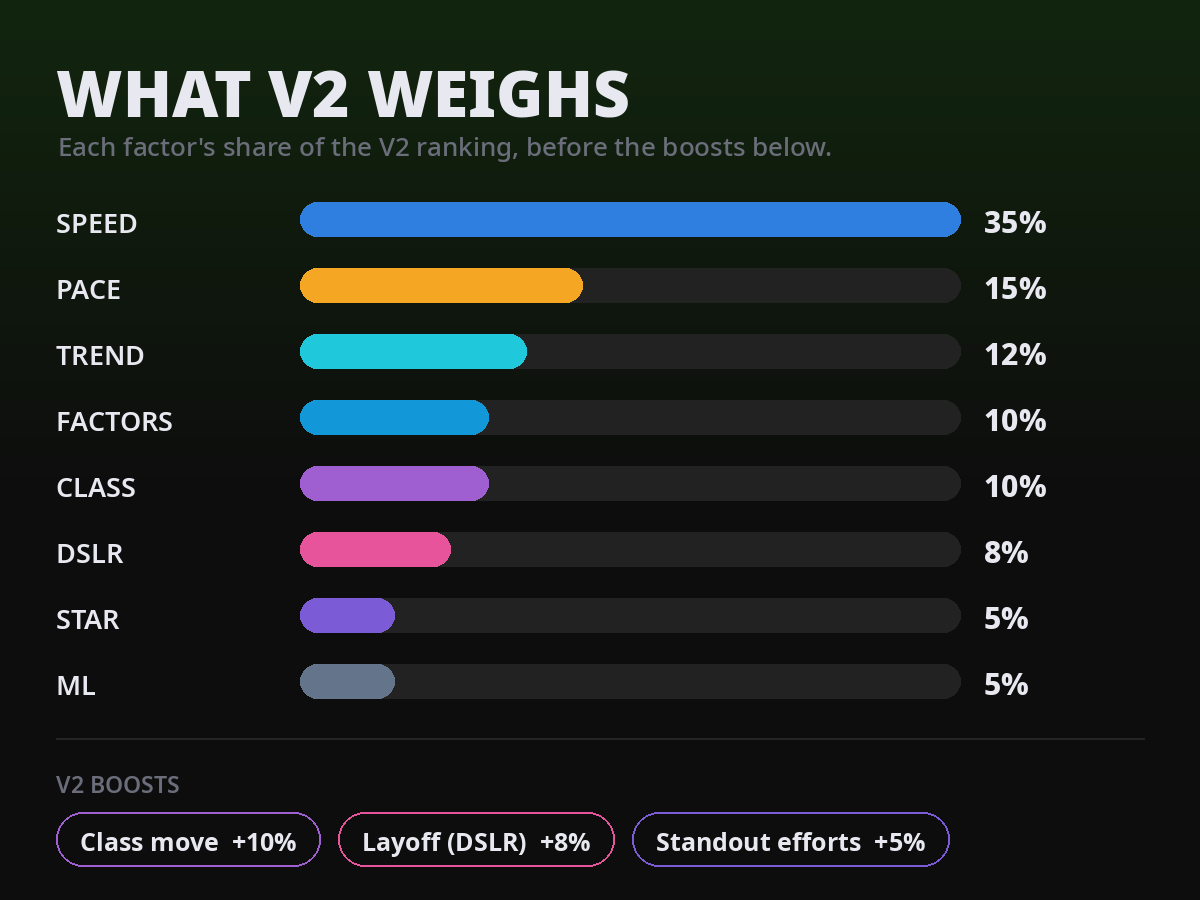
Three shifts matter most. Speed drops from 45% to 35%: still the biggest single input, but no longer half the answer. Pace triples, from 5% to 15%, because how a race unfolds (who makes the lead, who gets the trip) decides outcomes that raw figures cannot see; our pace analysis guide breaks down why. And two inputs appear that V1 does not weigh at all: class, and DSLR, the layoff between races. Meanwhile the morning line fades from 10% to 5%. V2 trusts the market's opinion half as much as V1 does.
The three V2 boosts
On top of the base weights, V2 applies three explicit boosts, listed under the chart on Edge:
- Class move +10%. A horse moving in class in a way the model likes — dropping into a softer spot, or rising in class off a strong effort — gets a push. Class is the oldest angle in handicapping, and our class handicapping guide covers how to read it.
- Layoff (DSLR) +8%. Time away is not automatically rust. Certain layoff patterns historically fire fresh, and V2 rewards them instead of penalizing the gap.
- Standout efforts +5%. One race in a horse's form that stands above the rest — an effort that says the horse is better than its recent line makes it look — earns a nudge upward.
Why a horse can move several places
Put it together and the V1-to-V2 moves stop looking random. Picture a field loaded with early speed, three horses who all want the lead. In V1, the fastest of them tops the list on figures alone. In V2, pace is worth three times as much, so the duel up front drags all three down, and the stalker or closer who gets the perfect setup climbs, sometimes several places, without its speed figure changing at all. Run the same logic in a paceless field and the lone-speed horse gets upgraded, because the shape hands it the race.
That is the whole point of running two models. When V1 and V2 agree, the fastest horse also fits the shape, and those are the strongest ratings on the board. The win probability on our daily pick cards comes from the Deep Insights V2 section, because V2 is the model that prices the race in front of us, not just the horses in it. When the two models disagree, the race is telling you something: ability says one thing, the setup says another, and those disagreements are usually where the value hides.
How to use this on Edge
On any race page, compare the two orders before you look at the probabilities. When V2 promotes a horse several places above its V1 rank, look for the reason in the shape: a pace edge, a class move, or a layoff pattern the model trusts. Start with today's free picks, browse the track hubs for the cards you play, and check both rankings before you settle on a race.
And if you want to run the numbers yourself: a full track is free every day on Edge — free account, and the track's a surprise when you sign up. Every race on that card shows both rankings, our Edge V2 model's win probabilities, value alerts and exotic tickets, at edge.acesandraces.com/free. Paid members get every track, every day.
Aces Edge predictions are generated by a mathematical model for informational purposes only. This is not a bet recommendation. Past model performance does not guarantee future results. Please gamble responsibly.
Want picks like this every day?
Ranked picks with win probabilities, bomb & value alerts, exotic ticket builds, and Pick 3/4/5 sequences — delivered before first post every morning.
Join the Edge — $14.99/mo →Free race of the day, in your inbox
One race, every morning, before first post. No charge, unsubscribe any time.
No spam. Unsubscribe any time.