Kentucky Derby Winning Times: What 130 Years of Data Tells Bettors
The record has stood since 1973. Winning times have plateaued for 70 years. Here's what the full historical data actually means for how you should handicap the 2026 Derby.
Drew
Lead Handicapper · Aces & Races
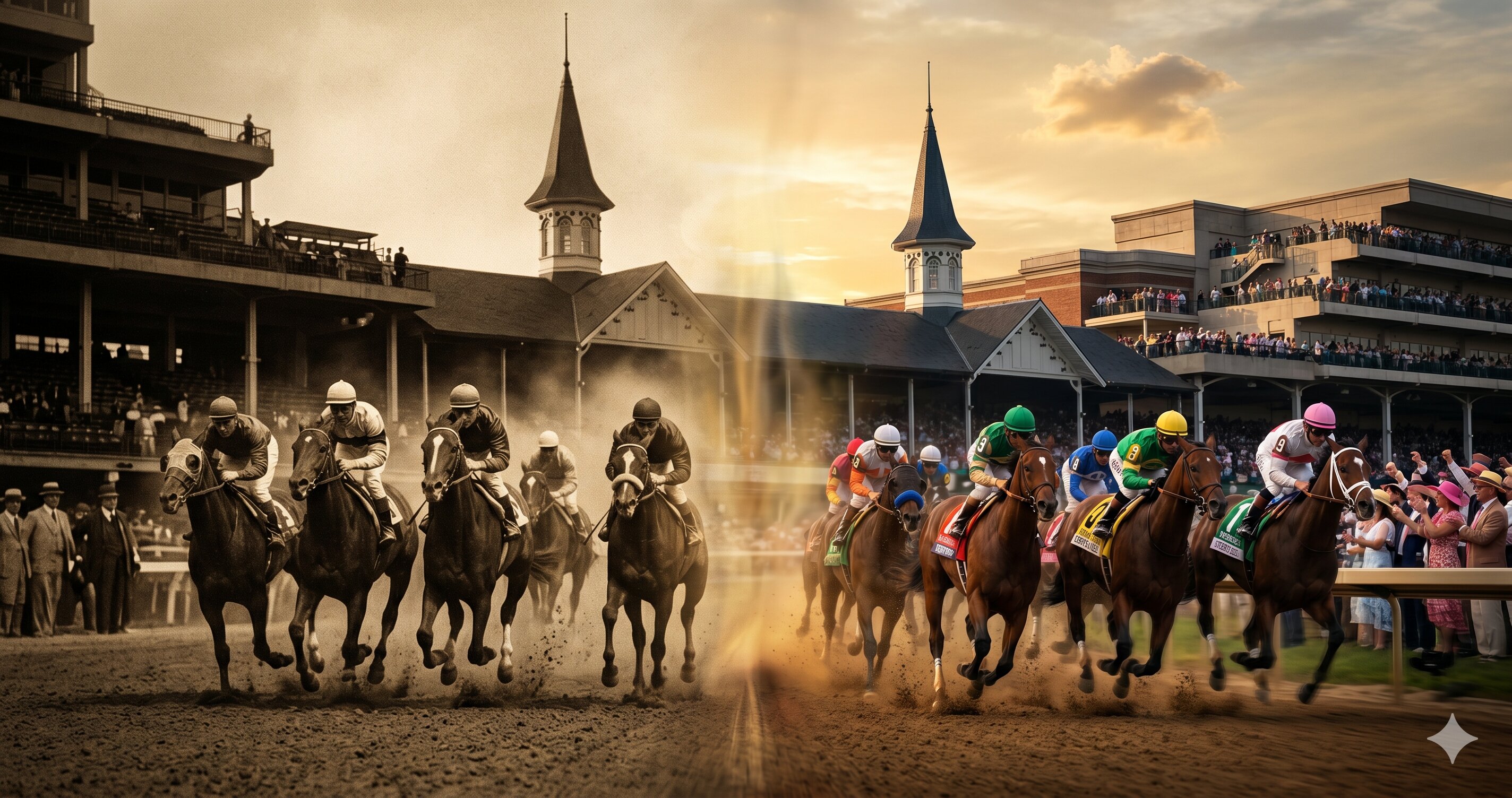
Why Winning Time Actually Matters — and When It Doesn't
Every year around Derby week, someone trots out the final time as proof that a horse ran a great race. Every year, experienced handicappers mostly ignore it. Final time is the output of a dozen variables you couldn't control — track condition, pace shape, field size, weather, where your horse sat in traffic. A 2:02 on a fast track through a soft pace means something completely different than a 2:02 on a wet-fast strip with a brutal early fractions.
That said, 130 years of Derby finishing times tell a story worth understanding. The trends are real, the records are meaningful, and — most importantly — the patterns reveal what to watch for when you're handicapping the 2026 running on May 2.
The Distance Change That Started Everything
The first 21 editions of the Kentucky Derby were run at a mile and a half. The race shortened to its current 1¼-mile distance in 1896, which is where the modern record books begin. Everything before 1896 is a different race at a different distance — apples to oranges.
In those first four years at the current distance, winning times averaged 2:10.31. Ben Brush won the inaugural short-course Derby in 2:07.75. Typhoon II ran a sluggish 2:12.50 in 1897. By today's standards these look slow, but track maintenance, equipment, and breeding were all primitive by comparison.
Early Decades: Slow Progress
The first decade of the 20th century shaved a full second off the average — down to 2:09.58 — but individual races still varied wildly. Stone Street ran 2:15.20 in 1908, the slowest Derby on record at the current distance.
| Year | Winner | Time |
|---|---|---|
| 1900 | Lieut. Gibson | 2:06.25 |
| 1904 | Elwood | 2:08.50 |
| 1908 | Stone Street | 2:15.20 |
| 1900–09 avg | — | 2:09.58 |
The 1910s were when things got interesting. The record fell three times in a single decade: Meridian clocked 2:05.00 in 1911, Donerail broke it with 2:04.80 in 1913, and Old Rosebud went 2:03.40 in 1914. Regret became the first filly to win the Derby in 1915 — running 2:05.40, a time that would have been a record just four years earlier.
| Year | Winner | Time |
|---|---|---|
| 1911 | Meridian | 2:05.00 |
| 1913 | Donerail | 2:04.80 |
| 1914 | Old Rosebud | 2:03.40 |
| 1915 | Regret | 2:05.40 |
| 1910–19 avg | — | 2:06.36 |
Triple Crown Era: Better Horses, Better Times
The 1930s and 1940s produced some of the most legendary names in thoroughbred history — Gallant Fox, Whirlaway, Count Fleet, Citation — and times improved accordingly. The Triple Crown winners weren't just great horses. They were great horses running fast in an era when breeding programs were maturing and track prep was improving.
Whirlaway's 2:01.40 in 1941 stood as the Derby record for more than 20 years. Twenty Grand ran 2:01.80 in 1931. The decade average dropped to 2:04.54 in the 1930s — a full two seconds faster than the 1910s.
| Year | Winner | Time |
|---|---|---|
| 1931 | Twenty Grand | 2:01.80 |
| 1937 | War Admiral | 2:03.20 |
| 1941 | Whirlaway | 2:01.40 |
| 1943 | Count Fleet | 2:04.00 |
| 1948 | Citation | 2:05.40 |
| 1940–49 avg | — | 2:04.90 |
The 1950s Leap — and Why It Matters
If you're looking for a single decade that changed the Derby's baseline, it's the 1950s. The average winning time dropped to 2:02.54 — the biggest single-decade improvement since the race moved to 1¼ miles. In the entire 1940s, five Derby winners ran 2:05.00 or slower. In the 1950s, only Tim Tam in 1958 ran that slow.
Modern track maintenance, better equipment, improved training methods, and the influence of stronger breeding lines all converged in this decade. The 1950s essentially set the floor that most Derbys have been running at ever since.
The Fast Era: 1960–1985
The records started falling again in the 1960s. Decidedly broke Whirlaway's 22-year-old mark with a 2:00.40 in 1962. Northern Dancer ran an even 2:00.00 flat in 1964 — a record that stood until 1973. Proud Clarion went 2:00.60 in 1967. Three sub-2:01 clockings in a single decade pushed the average to 2:01.64.
| Year | Winner | Time |
|---|---|---|
| 1962 | Decidedly | 2:00.40 |
| 1964 | Northern Dancer | 2:00.00 |
| 1967 | Proud Clarion | 2:00.60 |
| 1960–69 avg | — | 2:01.64 |
Then came Secretariat.
The 1973 Derby record of 1:59.40 wasn't just a record — it was a statement that no one has answered in 53 years. Secretariat ran each quarter-mile faster than the one before it, a pace distribution that is essentially impossible to replicate. His final time remains the only sub-2:00 Kentucky Derby on record.
Spend a Buck came the closest in 1985 at 2:00.20. Monarchos ran 1:59.97 in 2001 — officially sub-2:00 by the hundredths-of-a-second timing used since the 1990s, though it still trails Secretariat comfortably under any measurement standard.
The Plateau: 1986 to Present
Here's the number that should recalibrate your expectations heading into any modern Derby: since 1950, the average winning time has fluctuated within a remarkably narrow 3-second band — roughly 2:01 to 2:04, depending primarily on track condition that day.
The 2010s averaged 2:03.09 — the slowest decade since the 1940s — but context explains it entirely. Five of the ten Derbys that decade were run on tracks rated sloppy or wet fast. Wet tracks slow times. That's not a reflection of horse quality; it's weather.
| Year | Winner | Time |
|---|---|---|
| 2010 | Super Saver | 2:04.45 |
| 2015 | American Pharoah | 2:03.02 |
| 2016 | Nyquist | 2:01.31 |
| 2018 | Justify | 2:04.20 |
| 2010–19 avg | — | 2:03.09 |
The 2020s have recovered to a solid 2:01.91 average, with Authentic (2:00.61 in 2020) and Mandaloun (2:01.02 in 2021) both running sub-2:02. Last year's winner Sovereignty ran 2:02.31.
What This Means for Handicapping the 2026 Derby
Three factors will determine the 2026 winning time more than any individual horse's ability:
1. Track Condition
A fast Churchill Downs strip produces times in the 2:00–2:02 range. A sloppy or wet-fast track pushes that to 2:03–2:05. Check the weather forecast the week of the race. If rain is in the forecast, adjust your expectations — and your bet strategy — accordingly. Closers tend to outperform on off tracks; lone-speed horses often underperform.
2. Pace Shape
Secretariat's record came from a pace scenario that's nearly impossible to recreate: clean, unchallenged fractions that accelerated through the stretch. When multiple speed horses contest the early lead, fractions get brutal and closing times suffer — even if the final time looks "normal." A 2:02 through a :45 half is a very different race than a 2:02 through a :47 half.
Identify the speed horses in the 2026 Derby field before you bet. If there are three or four horses that want the front, the pace will be contested — and the closers gain a significant edge. If there's lone speed, that horse has a real shot to wire the field regardless of final time.
3. Field Size
The Derby allows up to 20 horses. A full field creates traffic complications that affect pace distribution and, ultimately, final time. Horses that draw wide post positions in a big field burn energy covering extra ground early — time that doesn't show up in fractional splits but absolutely shows up in the stretch.
The All-Time Record: Is It Ever Falling?
Secretariat's 1:59.40 has stood for 53 years. Monarchos came within four-tenths of a second in 2001. No one else has been within a full second since the 1970s. The honest answer is that the record is probably safe indefinitely — not because today's horses are slower, but because the pace scenario that produced it is essentially unrepeatable.
Don't handicap the 2026 Derby looking for a record breaker. Handicap it looking for pace mismatches, track condition advantages, and horses whose running styles fit the probable race shape. That's where the money is — not in predicting a 53-year-old record finally falls.
Check our full Kentucky Derby 2026 picks and contender analysis, or get race-by-race selections with win probabilities and exotic ticket builds through The Edge.
Want picks like this every day?
Ranked picks with win probabilities, bomb & value alerts, exotic ticket builds, and Pick 3/4/5 sequences — delivered before first post every morning.
Join the Edge — $14.99/mo →