How to Read Morning Line Odds Like a Professional Handicapper
The morning line is the track oddsmaker's opening salvo — not a prediction, but a conversation starter. Here's how sharp bettors actually use it to find value before a race goes off.
Drew
Lead Handicapper · Aces & Races
What the Morning Line Actually Is
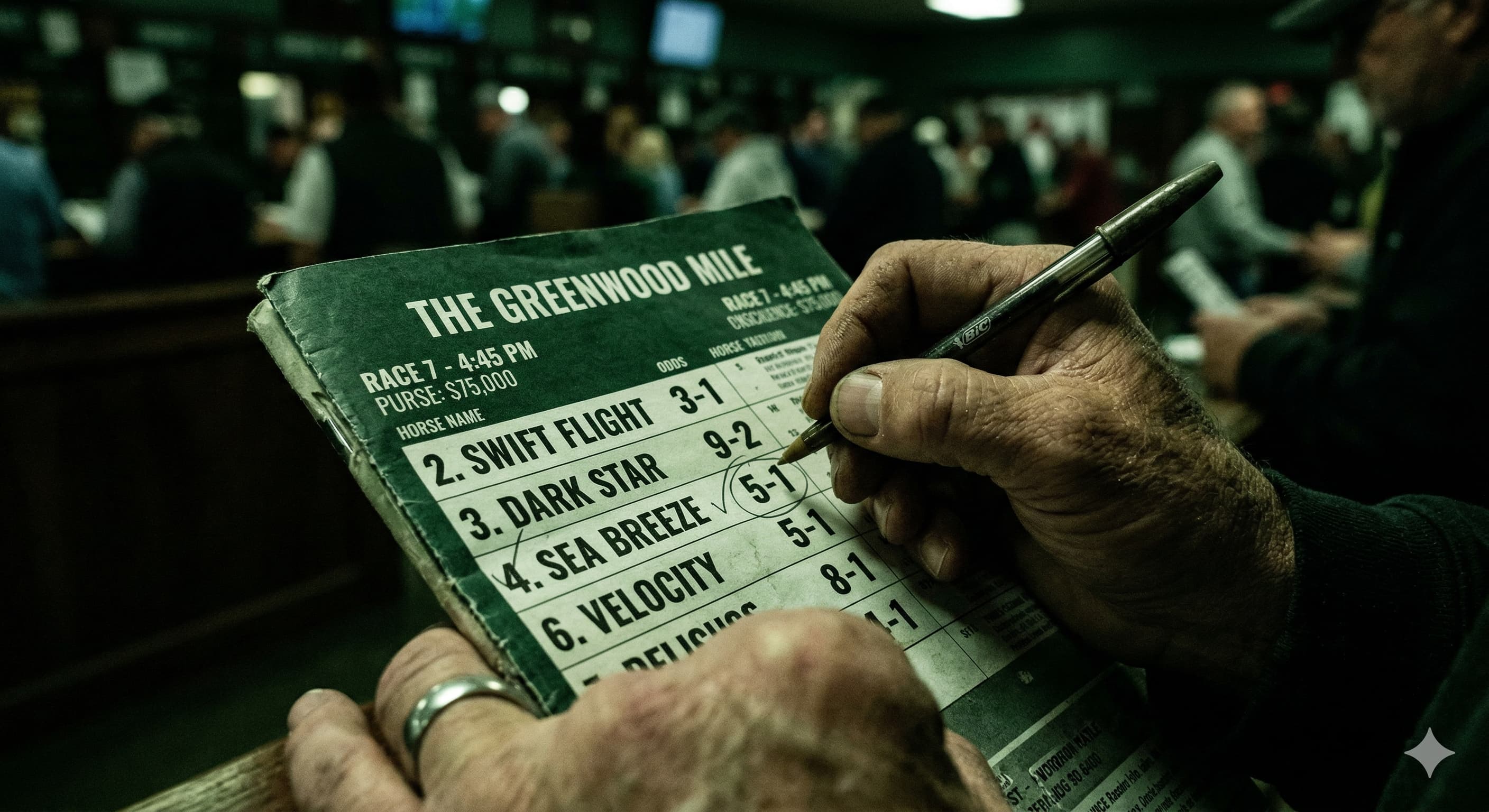
Every day before post time, the track oddsmaker sits down and assigns opening odds to every horse on the card. That line — the morning line — gets printed in the program, posted on the tote board, and published across every data feed from Equibase to DRF.
Most casual bettors treat it as gospel: if the morning line says 5-2, they assume the horse has roughly a 28% chance of winning. That assumption costs them money every single day.
The reality? The morning line is the oddsmaker's educated guess at where the public will bet — not a probability model. The best oddsmakers in the country are remarkably accurate at predicting crowd behavior. That's their job. Their job is not to tell you which horse will win.
"The morning line is a model of the crowd. The final odds are the crowd. The truth is somewhere else entirely."
Morning Line vs. Live Odds vs. Final Odds
Three different numbers all get called "the odds," and confusing them is the fastest way to misread a race. Here is what each one actually represents:
- Morning line odds — the oddsmaker's pre-set forecast, published the night before or the morning of the race. Nobody has bet a dollar yet, and it never changes once posted.
- Live (tote) odds — the real-time price generated by actual money in the pools. These update every 30–90 seconds as bettors wager, right up until the gate opens.
- Final odds — the live odds frozen at post time. These determine your payout — not the morning line, and not even the odds you saw at the moment you bet.
Because pari-mutuel payouts are set by the final pool, the morning line is never a price you can actually bet into. It is a reference point, nothing more — the starting hypothesis you spend the rest of the morning trying to disprove.
The Gap Between Morning Line and Final Odds
Here's where sharp handicappers earn their edge. When you see a horse open at 8-1 and close at 3-1, that's money talking. Serious money — syndicates, data-driven betting operations, professional players — pushed that horse down. They saw something the morning line didn't price correctly.
Conversely, when a horse opens at 3-1 and drifts to 7-1 by post time, the public is abandoning it. Sometimes that's noise. Sometimes it's a late scratch that changes the pace scenario, a bad work, or a hot tip from the barn going the wrong direction.
At Aces & Races, one of the first things we check every morning is the gap between our projected win probability and the morning line implied probability. That gap is where value lives.
How to Calculate Implied Probability from Odds
The math is simple. For fractional odds of X-to-1, implied probability = 1 ÷ (X + 1). Here is the full conversion for the prices you will see most often on a card:
| Odds | Implied win probability | What it usually means |
|---|---|---|
| 1-5 | 83.3% | Prohibitive favorite |
| 4-5 | 55.6% | Strong favorite |
| 9-5 | 35.7% | Solid favorite |
| 5-2 | 28.6% | Second choice |
| 3-1 | 25.0% | Live contender |
| 5-1 | 16.7% | Mid-pack |
| 8-1 | 11.1% | Longshot with a chance |
| 15-1 | 6.3% | Deep closer / price play |
| 30-1 | 3.2% | Bomb |
Now here's the catch: the sum of all implied probabilities in a race always exceeds 100%. That extra is the takeout — the track's cut, baked directly into the odds. On a full field the "overround" can push the total to 118–125%. This is the built-in house edge you are always fighting.
Sharp handicapping is the art of finding horses whose actual win probability is higher than what the market implies — by enough to overcome the takeout and generate long-run profit.
Takeout: The Tax Hiding Inside Every Price
Takeout is the percentage the track removes from each betting pool before paying winners. It varies by track and — critically — by bet type. Exotic wagers almost always carry a steeper tax than straight win bets:
| Bet type | Typical takeout |
|---|---|
| Win / Place / Show | 15–18% |
| Exacta / Daily Double | 18–22% |
| Trifecta / Superfecta | 20–25% |
| Pick 3 / Pick 4 / Pick 5 | 15–25% |
The lesson isn't "never bet exotics" — it's that every wager clears a different hurdle. A horse that's a small overlay to win can be a much bigger overlay underneath, where the crowd overbets favorites. Knowing the takeout tells you how big your edge has to be before a bet is worth making.
The Favorite-Longshot Bias
Decades of pari-mutuel data reveal a persistent market flaw: bettors systematically overbet longshots and underbet favorites. Horses at 20-1 and up win meaningfully less often than their odds imply, while short-priced favorites win slightly more often than theirs. That's the favorite-longshot bias.
It doesn't mean "always bet favorites" — takeout still eats most of that edge. But it does mean the lottery-ticket 40-1 shot you're tempted by is usually an even worse deal than its already-long price suggests, while a solid, correctly-handicapped favorite the line has at 8-5 is often the more honest number. Weigh your longshots accordingly.
Three Morning Line Red Flags
After years of studying morning lines across every major circuit, here are the three patterns we see signal mispriced horses most reliably:
1. The Compressed Favorite
When a heavy-money stable enters a prohibitive morning-line favorite — think 3-5 or lower — the public piles on. Often the true odds should be shorter, and value shifts to the field. Look for the second or third choice with a realistic shot at the price differential.
2. The Overlooked Closer on a Speed-Favoring Card
Oddsmakers price horses partly based on historical public betting patterns. Closers get underestimated when the card is biased toward early speed, because the oddsmaker knows the public will bet the front-runners. When track bias flips, that 15-1 closer becomes 7-1 in reality.
3. The Shipper Discount
A horse shipping in from a smaller circuit — say, Turfway to Churchill — often carries a morning-line penalty because the oddsmaker knows the public doesn't trust the form. If the horse's Beyer figures, trainer stats, and pace setup all line up, that discount is free money.
A Worked Example: Reading One Race
Say a six-furlong sprint has three main players on the morning line:
- #3 at 8-5 (38.5% implied) — the speedy favorite, but two other need-the-lead types are drawn inside him.
- #6 at 7-2 (22.2% implied) — a closer who ran evenly last out on a speed-favoring track.
- #1 at 6-1 (14.3% implied) — early speed from the rail, one of the three horses who all want the front.
Map the pace and the story changes. Three horses gunning for the lead means a contested, fast early fraction — which tends to collapse in the lane and set up the closer. Our model might peg #6's true chance at 32%, not 22%. That's a clear overlay: we're getting 7-2 on a horse that should be closer to 2-1. Meanwhile the 8-5 favorite, likely to get run at by every call, is an underlay we happily bet against.
The morning line didn't tell us who wins. It told us where the crowd's money — and therefore the mispricing — would be.
Common Mistakes Bettors Make With the Morning Line
- Betting the line as if it were the payout. You're paid at the final odds, not the printed number. A 5-1 morning-line horse bet down to 2-1 is a completely different wager.
- Assuming the favorite is "due" to be right. Morning-line favorites win only about a third of the time. Two-thirds of the time, the answer is somewhere else.
- Ignoring pace and bias. The line prices reputation and public perception. It does not price the way today's race will actually unfold.
- Chasing steam blindly. A plunging horse is information, not a mandate. Confirm it against your own handicapping before you follow the money.
Putting It Together: The Morning Line as a Lens
We don't bet the morning line. We bet against the morning line's mistakes.
Every pick published here at Aces & Races starts with our proprietary model — a quantitative layer that assigns each horse a win probability independent of what the market says. When that probability meaningfully exceeds the morning line's implied probability, and our qualitative handicapping confirms the edge, that's a play.
The morning line is noise filtered through a useful lens. Learn to read the distortions and you'll start seeing things the betting public never will.
To build a complete probability framework, see our guides on speed figures, reading past performances, and class handicapping — the inputs that power our morning-line comparison every day. When you're ready to put it to work, our free daily picks show the method applied to real cards.
Key Takeaways
- The morning line predicts public betting behavior, not race outcomes.
- It is a forecast, not a price — you're paid at the final odds set by the pools.
- The gap between morning line and final odds reveals where sharp money moved.
- Always convert odds to implied probability and compare against your own model.
- Account for takeout — your edge has to clear it, and it's bigger in exotics.
- Respect the favorite-longshot bias: longshots are worse bets than their odds suggest.
- Look for shippers, closers on speed-biased cards, and compressed favorites for the most reliable mispricing patterns.
Frequently Asked Questions
What does the morning line mean in horse racing?
The morning line is the track oddsmaker's forecast of what each horse's final odds will be, based on how they expect the public to bet. It's published before wagering opens — a prediction of crowd behavior, not the actual payout and not a measure of which horse is most likely to win.
Who sets the morning line odds?
A track-employed oddsmaker (or "linemaker") sets them, usually the night before or the morning of the race, after entries and post positions are drawn. Different tracks use different oddsmakers, which is why line-making styles vary from circuit to circuit.
Are the morning line odds what I get paid?
No. Horse racing is pari-mutuel: your payout is determined by the final odds when the gate opens, calculated from the actual money in the pools. The morning line is only a starting reference.
Should I bet the morning line favorite?
Not automatically. Morning-line favorites win only about 30–35% of the time, so most races are won by another horse. Use the line to find horses whose real chance is better than their price, rather than blindly backing the shortest number.
Want to see how we apply this every race day? Join the Edge — our members get daily picks with full reasoning, model ratings, and best-bet callouts before first post.
Want picks like this every day?
Ranked picks with win probabilities, bomb & value alerts, exotic ticket builds, and Pick 3/4/5 sequences — delivered before first post every morning.
Join the Edge — $14.99/mo →